Sunday, July 14, 2013

1-10 Recap

What I’m watching: Movies: Dead Snow
 
            Well, I’m off to a slow start. But that’s what I expected, being a slow reader after all. Now that I’ve done ten books (actually, eleven with two Ten Little Indians), I just wanted to do a little retrospective of my time during the past ten posts and write about some things happening outside of what books I read. I plan to make these little recaps after every ten books.
Part of the decision came from my realization that just writing down the name of a television show or videogame doesn’t indicate how much time I gave to it. Movie titles, on the other hand, are explanation enough. Each one stands alone and has a set amount of time for it. So, I figure I can use this as an opportunity to discuss any TV or gaming (or movies, too – it’s my blog!) that I gloss over in my regular posts. I also want to keep a total of how many books are staying versus going.
 
Wedding: Well, I got 15 more months until the big day. Since I started my blog, Olivia and I finished asking all 14 members of our wedding party to confirm that they want to stand up with us. All yeses. That makes me glad. We have a church we want, but we still need a reception venue. We’ve searched plenty of places, but they are either too small or too expensive. We still have a few ideas to check into. We got our engagement photos half-taken. Olivia and I had a weekend of seriously considering moving up the wedding by a year.
 
TV: I watched the entire series of Cadfael. I love that show! There are only 13 episodes, but each one is 75 minutes long. My favorite character, apart from Cadfael, got replaced after the first season, which sucked, and then the replacement got replaced for the last season. Olivia and I barreled through the first two seasons of Downton Abbey. Another amazing British show. Mr. Bates and Anna were immediately my favorite characters. I’ll admit, I really liked Lavinia and part of me preferred her to Mary. Mary lost some major points with me after turning down Matthew while the entail was being questioned. Off and on I would join Olivia as she marathoned all of the Office. I watched all of Twin Peaks season 2. I was disappointed with the show’s end. I’ve heard the movie sucks ass, but I was still going to watch it until I heard that it’s a prequel. Dammit, I just want some closure! I watched the first two seasons of Once Upon a Time. That show’s pretty cool. I don’t really like the actor playing Emma Swan. She always has a grimacey frown on her face, no matter what’s happening.

I hope I made my point. Olivia and I watched the first two series (that means seasons in British) of Misfits. The first series is amazing and was hard to put down. It’s very funny and very thrilling. Series two was really awesome as well. However, we started watching the beginning of series three, but there were so many changes (worst of all, our favorite character left the show) that we weren’t enjoying it at all. So we stopped and haven’t gone back.
 
Movies: I never got around to that Tarantino marathon. Damn. I still mean to do that.
 
Videogames: I started and beat the Uncharted trilogy, God of War 3, Far Cry 3, Bioshock: Infinite, and the Injustice: Gods Among Us story mode during my blog. Uncharted was amazing, and the third game was epic all the way through. So many awesome set pieces, such as the sinking ship, the plane falling apart in the sky, the train convoy from 2…all three games were super fun. The first Bioshock is still my favorite story, and I think Bioshock 2 is my favorite gameplay, what with the dual-wielding plasmid and weapon. And the drill. There was not enough Songbird in Infinite. It was still a good game. I tried picking it up later to try 1999 mode, but I got my ass handed to me pretty much as soon as the fighting started. I started Dead Space 3, but I hit a wall of being scared once the necromorphs jumped up in difficulty. After finishing Twin Peaks, I picked up where I left off in Deadly Premonition (because I guess that’s the next best thing to a sequel I’m going to see). I created new characters in both Fallout 3 and Skyrim. Olivia and I started a band in Rock Band, The Mistake. We collected all the Star Coins in Mario.
 
Running Total: 3 Staying, 8 Going.

10. Geekspeak

Book: Geekspeak: How Life + Mathematics = Happiness
Author: Dr. Graham Tattersall
Number of pages: 239
What I’m watching: TV: The Office, The Mindy Project, Downton Abbey, Black Adder, Cadfael Movies: The King’s Speech, Much Ado About Nothing (2013), Back to the Future, Robots, Tomb Raider, How to Train Your Dragon, Wayne’s World, The Wrong Trousers
What I’m playing: The New Super Bros, Far Cry 3, Rock Band, Skyrim, Crysis
 
            For whatever reason, I just kept putting off this post. Maybe I wasn’t sure how I felt after reading my next book, Geekspeak.

Well, first off, I picked this book up and a sale of donated books. Turns out this copy is an “UNCORRECTED PROOF: NOT FOR SALE” (front cover). Too late, I already paid for it. What’s more: “Reviewers are reminded that changes may be made in this proof copy before books are printed. If any material from the book is to be quoted in a review, the quotation should be checked against the final bound book” (back cover).1 Fuck that, this blog is about reading the books I have on my bookshelves. I’m not going out and buying a second copy to add to my shelf. The idea of my blog is to subtract from my shelves. The back cover claims that “Geekspeak does for problem-solving what Freakonomics did for economics.” I remember thinking Freakonomics was awesome, so I had strong hopes for liking this book.
            It starts off pretty good. Dr. Tattersall talks about how big people’s vocabularies are. He suggests using random sampling of dictionary pages to figure out about how many words you know. He mentions a study done in Britain (he’s British) analyzing recorded conversations which revealed that the top three words spoken by women were “she, her, [and] said” and the most frequent words said by men were “fucking, er, [and] the” (6; 7).
That feeds into some certain assumptions about the genders. Gossipy women and stupid men. Hell, “er” isn’t even a fucking word!2 I feel like “er” is a more British filler syllable. I remember Harry Potter saying it in Book 4, but I feel like Americans are more apt to say “uh” or something close to the schwa sound(of course, I’m pulling this er vs. uh stuff out of my ass). Still, I find that study intriguing.
He also graphed out the frequencies of different word-lengths of Jane Austen’s Pride and Prejudice as a way to identify her unique vocabulary. This is the kind of random crap I like. I had the idea of counting up the spoken words per minute of Gilmore Girls and comparing it to other TV shows, because the joke is that they talk so much faster on that show than real life or other shows.
I wanted to do a statistical analysis to see if there’s any significant difference. I guess that means I speak Geek.
            Then he does stuff like explaining horsepower, estimating how heavy a house is, and using math to explain “Six Degrees of Kevin Bacon” (except since he’s British, he uses the Queen, not Ren McCormack). Sometimes I like what he’s writing about, but as I’m reading, I’m growing more and more bored with Geekspeak. I don’t really care how much a house weighs.
            So, the book’s basic structure is Dr. Tattersall puts forward a question, a little anecdote or pop culture reference to lead into the answer, and then he answers the question using a mathematic formula and plugging in estimated numbers. He’ll mention Captain Kirk or Mark Haddon’s The Curious Incident of the Dog in the Night-time (my second favorite book I’ve ever read), but leaves it behind to talk about math that sometimes doesn’t really connect back to it.
A chapter will start off cool, but end up as a rough guess to a useless fact.
            Instead of quoting an entire chapter, this is me imitating a chapter:

            How busy is rush hour?
            According to Doc Brown, in 2015, “we don’t need roads.” But for now, I have to stick to my highway commute to and from work. When I’m stuck in bumper to bumper traffic, how many people am I looking at driving opposite me on the other side? To figure this out, I need to know how many cars I see and how many people are in each car. We can use the formula

People = Length of lane X lanes X cars per lane X people per car

On a straight, flat stretch of road, I’d say I can see about a quarter-mile clearly. One mile is 5,280 ft. Divide that by four to get how much I can see. Let’s just make it 1,000 ft. A car is about 12 ft long. To account for the space in between each car, I’ll just round up to one car per 20 ft of road. So, I’m seeing 50 cars down one lane. But where my car is sitting I-94 has three lanes. That makes it 150 cars. How many people are in each car? I don’t need to run around each vehicle and do a census Frogger-style. I can just get a look at a sample of 10 cars and apply those results to the whole population of rush hour traffic. My result turned out as 9 cars with only one person. One car had a driver and a passenger. That makes an average of 1.1 people per car. Multiply that by the number of cars and I now can reasonably guess that I am looking at 165 people across the cement divider.
 
           The worst part is that so many of the numbers end up being arbitrary. Discussing clouds, Dr. Tattersall writes “a true Geek will have a go at working it out, but will also recognize that the estimate could easily be ten times too big or ten times too small. Cloud thickness ranges from hundreds to thousands of feet; for simplicity, let’s go for a 1,000-foot (1/5 mile) thick, 1 mile long and 1 mile wide cumulus cloud” (226). The same thing goes for pretty much all of his facts. He’ll give a range, sometimes differing by millions, and pick a simple number in the middle. It leaves me wondering, how factual are his facts?
            But then again, I’ve found myself bringing up some of these random and useless facts in conversations.3 Sometimes I really enjoy Dr. Tattersall’s topic, like which  personality descriptors are used most in personal ads. On the other hand, I don’t give a shit about how much a bus weighs.
At one point, he’s pondering how large an angel’s wings would need to be to work (one of the interesting ones), and he writes “estimating the weight of a soul is beyond the scope of this book” (149). Lucky for me, soon I’ll be reading Spook for my blog, which I’m pretty sure works at answering that very question!
He figures out whether or not there are more people alive than the total of all people who have ever lived. What?! How is that even a question? Apparently, all lot of people have been saying that. How could there be more people alive today than the total number of past lives of humanity spanning the entire history of the world? That idea sounds unbelievably ridiculous to me. And yet, the doctor describes an enormous population explosion over the past few centuries and how technological advances allow more food production than ever before. In the end, he estimates the number of all the past dead to be four times the number of all the current living. That still seems to be too small a difference to me.
After finishing reading, the problem with deciding the fate of Geekspeak is that the book switches every chapter between being cool as ice and boring as shit. Since the book is about math, I tallied up all the ones I liked. I liked 42.3% of the topics.
 
Verdict (Is the book staying or going?): Going. Was it worth a read-through? Yes. Do I plan on ever reading it again? No.
 
Notes
1. Did I just break that rule by using that quote?
2. Damn, how many times have I said “fuck” so far? Or “the,” for that matter?
3. Such as 20 mph farts.
 
Works Cited
Tattersall, Graham. Geekspeak: How Life + Mathematics = Happiness [uncorrected
          proof]. New York: HarperCollins, 2007. Print.

Tuesday, June 18, 2013

9. The Mouse and the Motorcycle

Book: The Mouse and the Motorcycle
Author: Beverly Cleary
Number of pages: 159
What I’m watching: TV: The Office
What I’m playing: Need for Speed: Most Wanted, Kingdom Hearts, Far Cry 3


            I rolled a four! Honestly, this was the one I wanted to read next, anyway.
I remember loving Beverly Cleary’s tales about Henry, Ribsy, Beezus, and Ramona as a kid. I also remember Runaway Ralph, the ABC TV-movie based on The Mouse and the Motorcycle’s sequel, with stop-motion mice and a young Fred Savage. For me, reading this book would be like eating a slice of my childhood out of some nostalgia pie, even though I've never read this particular book.
            So, Ralph the mouse lives in a hotel wall with his family. They make a living by eating fallen crumbs from guests in their room. A family stops by and the kid, Keith, gets the room to himself. He brings along toys, including a –whaddaya know– motorcycle. At his first opportunity, Ralph checks out the motorcycle close-up, fascinated by it. Beverly Cleary is pretty funny. As Ralph gushes over the toy, he thinks “it even had a little license plate so it would be legal to ride” (23). I enjoyed that. Ralph mounts the motorcycle, and not too long after, crash lands into the garbage basket and can’t escape. Oddly enough, all the while Ralph is failing at climbing out of the little bin, the illustrator included a picture of Ralph successfully knocking the basket over.
There’s a picture in the book of something that doesn’t happen in the story, not even in Ralph’s mind.
            Keith comes and finds Ralph still stuck in the garbage with the motorcycle. Turns out they can talk to each other because “two creatures who shared a love for motorcycles naturally spoke the same language” (38-39). Groan…Anyway, Keith says Ralph can borrow the motorcycle at night, letting Keith play during the day. Keith explains that to make the motorcycle go, you have to make a motorcycle sound, like “pb-pb-b-b-b” (44). Groan…I guess I should’ve expected this kind of stuff in a kid’s book.
            I also didn’t expect coming across words I didn’t recognize. I graduated with an English degree, and Beverly Cleary just taught me two new words in a children’s story: “antimacassar” (14) and “zwieback” (33), a cloth furniture-cover and bread.
            I’m sad to say, I was bored throughout most of the book. Maybe I’ve outgrown The Mouse and the Motorcycle. I hope I would still enjoy Henry and Ribsy and Beezus and Ramona if I re-read those. Maybe I just don’t have the nostalgia factor here, even though this book was so close to being a part of my childhood.
Maybe The Mouse and the Motorcycle was just plain uneventful. Which I think is true. Ralph drives around the hallway at night. At one point, he pisses off a dog, but the dog is securely held in the arms of its owner, so nothing happens. Oh yeah, the dog and also the elderly busboy Matt, can talk with Ralph. I guess they love motorcycles, too? Later, Ralph drives into a pillowcase and loses the motorcycle to the laundry. Keith gets a fever one night, but there’s no medicine available. Ralph goes on an adventure to find an aspirin tablet. His search through the hotel for medicine might’ve been harrowing for a mouse, but it was too tame for me. I hope if I re-read Stuart Little, I’d still enjoy that.
Of course, again I have to remind myself that I shouldn’t have expected anything too intense for a kid’s book. Man, now I’m really worried that I can no longer appreciate good children’s literature.
            Anyway, Ralph finds a pill hidden until a dresser or something. He manages to get it back to Keith’s room. Transporting the pill was a big part of the book. Early in the book, I read how aspirin killed Ralph's father, so Ralph looking for aspirin is kind of a big deal for him and his family. Ralph’s father once kept an aspirin tablet in his mouth, but “the aspirin had dissolved with an unexpected suddenness, and Ralph’s father had been poisoned” (22). I actually know a guy who did that to try to relieve a toothache. However, aspirin is an acid, so it burned away his gums. In my psychopharmacology class at Stritch, I learned that it’s possible to overdose on aspirin. So when I was reading this part, I was thinking, “Yeah, that can happen, but poisoning from just one pill?” And then I thought, “Oh yeah, he’s a mouse.”
            In the end, Keith feels better and gives Ralph the motorcycle as a gift to keep. Everyone is happy. They all learned a few things, grew up a little, and so on.
            I’m just disappointed. I was excited for this book, and I ended up bored. I still like Beverly Cleary in general, and the book did have a few funny moments. This one just wasn’t for me.
 
Verdict (Is the book staying or going?): Pb-pb-b-b-b. This book is going.
 
Works Cited

Cleary, Beverly. The Mouse and the Motorcycle. New York: Avon Books, 1965. Print.

Saturday, June 15, 2013

8. Blood Men

Book: Blood Men
Author: Paul Cleave
Number of pages: 329
What I’m watching: TV: How I Met Your Mother, Spiderman, Cadfael, The Colbert Report, Big Bang Theory, Downton Abbey, Twin Peaks, The Office, Kim Possible
Movies: Star Trek: Into Darkness, Project A, Die Hard, Run Fatboy Run, MST3K: I Was a Teenage Werewolf
What I’m playing: Skyrim, Bioshock, Fallout 3, God of War 3, Super Smash Brothers Brawl, Left 4 Dead, Bioshock: Infinite, Need for Speed: Most Wanted, Deadly Premonition, Far Cry 3
 
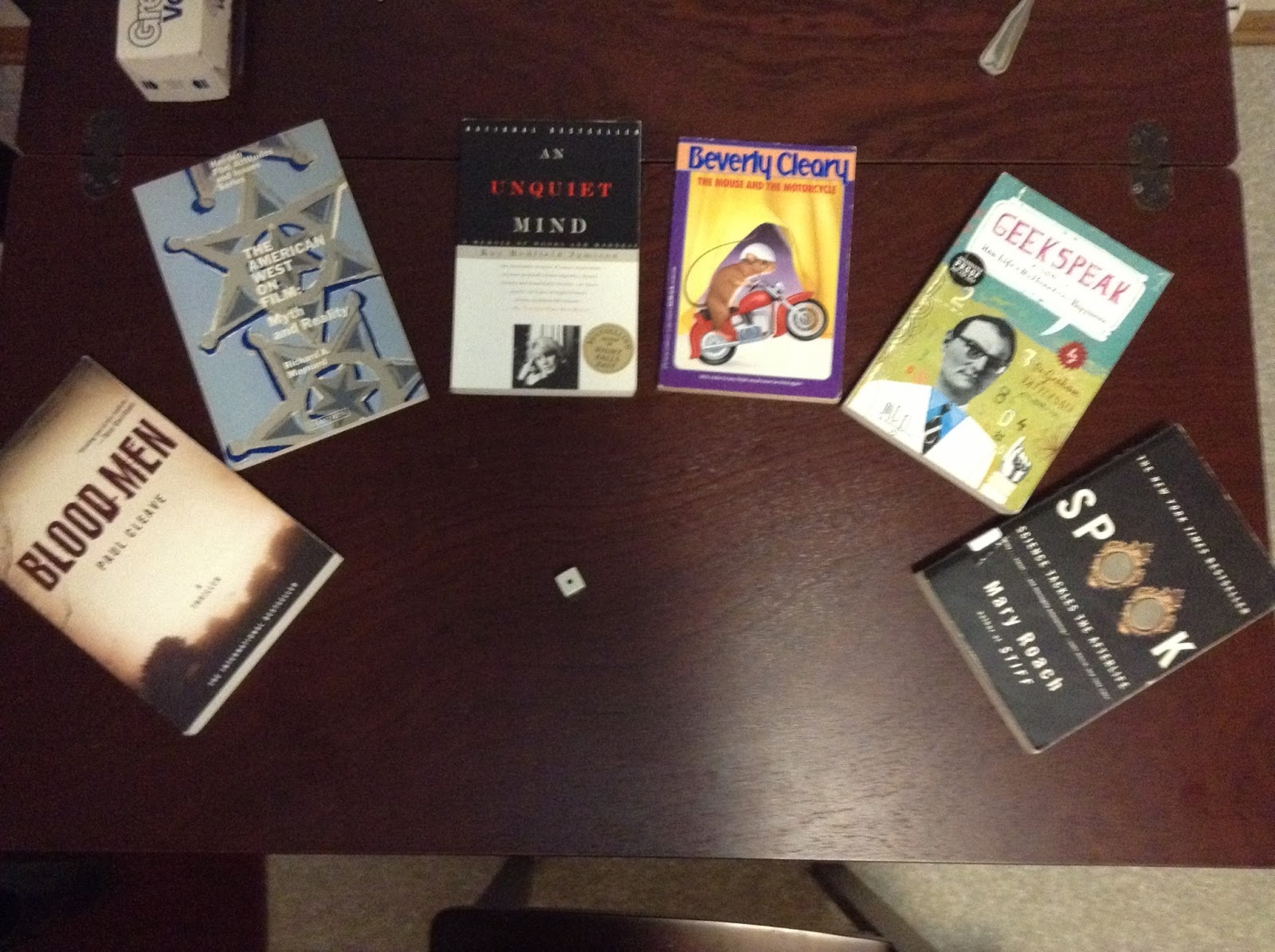
            So I picked out the next six books for my blog, and decided a new approach to the reading order. The roll of a die.
I rolled a one. I read the beginning of Blood Men some time ago, when I made a half-assed attempt at reading the first 10% of all my unread books to decide if they were worth keeping. Now, I’ve finally read the whole thing.
            Blood Men is set in Christchurch, New Zealand. All I knew about Christchurch before reading this book was a news story about a 2011 earthquake damaging the city’s iconic cathedral. If this fictional book is anything to go by, Christchurch is about as safe as Gotham.
They also do things in metric down there, which means 40 degrees is really hot and people measure in meters and kilos. Also, Christmas is during summer. And buildings are so many “storeys” high, not “stories.”
            WARNING! Minor spoilers. Edward, a 29-year-old son of a serial killer, is trying to lead a normal life, but the media speculates if he will turn serial murderer like his father. Edward has a wife and daughter, but early in the novel, his wife gets shot during a bank job. The plot centers on Edward seeking revenge on the bank robbers as he discovers that he does have an inclination toward killing. The narrative’s perspective switches between him and Schroder, a detective working the robbery case.
            Blood Men is a page-turner. It was thrilling and action-y. I also really enjoyed Paul Cleave’s writing style. He blends humor, action, and emotion very well. His depiction of Edward’s overwhelming grief moved me. It reminded me of Joker’s speech in The Killing Joke.
It also reminded me of Superman in the videogame Injustice: Gods Among Us.
In each case, Joker and Superman lost his wife and in his grief, went mad and turned to violence. Edward even thinks at one point, “my neighborhood is different – darker, everything gritty, it’s now the kind of place where only one bad day separates it between a suburbia and a war zone” (173; emphasis added). His view of the world altered after his one bad day, like the Joker. I try to imagine experiencing that same level of devastating loss, and I don’t know how I could cope. All in all, this book is depressing and violent.
            Edward turns to his imprisoned father, Jack, for help. Jack points toward paranoid schizophrenia as the cause for his murderous nature. Everyone in the book wonders whether Edward inherited his father’s mental disorder. This was where I had a bit of a problem with Blood Men. Let’s say that Jack does have paranoid schizophrenia. It is true that schizophrenia does have a strong biological influence. And, “research suggests that the paranoid type may have a stronger familial link than do people with the other types” (Durand and Barlow 479). So, there is a good chance that Edward has a predisposition for schizophrenia. However, family studies reveal that genetic inheritance of psychotic disorders is more complex:
All forms of schizophrenia (for example, catatonic and paranoid) were seen within the families. In other words, it does not appear that people inherit a predisposition for, say, paranoid schizophrenia. Instead, people may inherit a general predisposition for schizophrenia. More recent research confirms this observation and suggests that families that have a member with schizophrenia are at risk not just for schizophrenia alone or all psychological disorders; instead, there appears to be some familial risk for a spectrum of psychotic disorders related to schizophrenia. (Durand and Barlow 484)
Yes, there is a high likelihood that Edward would have schizophrenia. However, it would be a large assumption that Edward not only inherited the same type of schizophrenia, but also inherited the same murderous hallucinations of a voice telling him to kill in his symptoms. What I’m getting at is that I found the serial killer inheritance a bit far-fetched. However, Cleave throws a monkey wrench into those assumed works later in the novel. There are a few twists at the end. However, I guessed the twist that I think is supposed to fuel the last bit of the novel, so the ending kind of petered out for me. Nonetheless…
            Blood Men is a captivating read. Paul Cleave authored other thrillers, and if this one is anything to go by, the others are worth reading into.
 
Verdict (Is the book staying or going?): Staying.
 
Works Cited

Cleave, Paul. Blood Men. New York: Atria Paperback, 2010. Print.
Durand, Mark V. and David H. Barlow. Essentials of Abnormal Psychology. 5th ed.
Belmont, CA: Wadsworth, 2010. Print.

Saturday, May 25, 2013

7. Ten Little Indians

Book: Ten Little Indians
Author: Agatha Christie
Number of pages: 173
What I’m watching: TV: How I Met Your Mother Movies: First Men in the Moon, The Swan Princess, And Then There Were None1
What I’m playing: Dead Space 3, God of War 3, Skyrim


            Alright, now that I have zero homework, I am prepared to start knocking out some novels from my unread shelves. I’ve seen the film And Then There Were None, based on the book, but this was my first time reading the novel. There’s a 48 page reader’s supplement inserted in the book, which oddly enough, I have read. I read it for a paper I did on Agatha Christie, “The Dame that Came from Devon.” I wanted to find that paper because I don’t remember anything about it apart from the title, but I don’t think I saved a copy. The insert is pretty much a little background, pictures from the film, and short reviews of the novel.
            Ten Little Indians is a murder mystery, a genre at which Christie is superb. The back cover made it seem like the book had a different ending than the film, which renewed my intrigue toward the mystery. What’s more, Agatha Christie prefaces the novel with dramatic character descriptions such as “Emily Brent – A sixty-five-year-old spinster whose troubled dreams and rambling diary were the only indications of a disturbed – and perhaps dangerous – mind” and “Dr. Armstrong – At first the physician was a convenient dispenser of sedatives and diagnostician of causes of death, but later the others remembered that he was the only one who had easy access to poison” (Pocket Books 5). These did a wonderful job of priming me for the story. One thing was odd, though. Christie also included for each character the page of his or her first appearance. I’ve never seen that before in a book.
            The book opens with eight characters all mysteriously invited to Indian Island, coaxed either by a mention of an old friend or the promise of money. Agatha Christie excels at her characterizations. Simply the way each person travels indicates something. The people who came for the money are in a third-class train car. Anthony Marston raced to the boat in his fancy car, a character detail I will explain in a bit. Ten Little Indians has a lot of exposition, but Agatha Christie keeps it clever and entertaining.
            So, they all get to the island, which is nothing but bare rock except for the mansion and its two caretakers, Mr. and Mrs. Rogers. Turns out nobody has met the owner of the house, not even the Rogerses, who were only hired days ago. The mysterious host has yet to arrive. Before long, a recorded voice accusing all the guests and the servants of murder is heard on the gramophone. Throughout the play, the truth of each accusation is first denied then discovered.
            What loosens their tongues are the murders. One by one, the ten people on the island start meeting their deaths. It starts with Marston, guilty of running down two children in his speeding car, choking from poison. Each death follows an old nursery rhyme hung up all around the house, “Ten Little Indians:”
            Ten little Indian boys went out to dine;
            One choked his little self and then there were nine.
            Nine little Indian boys sat up very late;
            One overslept himself and then there were eight.
            Eight little Indian boys traveling in Devon;
            One said he’d stay there and then there were seven.
            Seven little Indian boys chopping up sticks;
            One chopped himself in halves and then there were six.
            Six little Indian boys playing with a hive;
            A bumblebee stung one and then there were five.
            Five little Indian boys going in for law;
            One got in Chancery and then there were four.
            Four little Indian boys going out to sea;
            A red herring swallowed one and then there were three.
            Three little Indian boys walking in the Zoo;
            A big bear hugged one and then there were two.
            Two little Indian boys sitting in the sun;
            One got frizzled up and then there was one.
            One little Indian boy left all alone;
            He went and hanged himself and then there were none. (28)
Chancery, as I looked up, refers to an English court. The host, U. N. Owen (a pseudonym), got all ten guests on the island to exact a personal justice on people who escaped the legal system. However, after a thorough search of Indian Island, the group finds that they are alone. Turns out Mr. Owen is one of the ten accused people. Ten Little Indians is a great murder mystery, so I don’t want to spoil a lot of details about who dies and who’s the killer.
            There are some things I do want to talk about. Two characters use the phrase “There’s a nigger in the woodpile” (31; 74). I tried looking up what that even means, and I guess it might have to do with escaped slaves hiding in woodpiles. Though the characters exhibit some racism, I wouldn’t say Agatha Christie comes off as racist herself. At least one character speaks against prejudice:
     Emily Brent‘s brow, which had been frowning perplexedly, cleared. She said, “Ah, I understand you now. Well, there is Mr. Lombard. He admits to having abandoned twenty men to their deaths.”
                 Vera said, “They were only natives…”
                 Emily Brent said sharply, “Black or white, they are our brothers.” (69)
So, the racism in Ten Little Indians is only in beliefs held by certain characters, unlike Hilda Manning’s inherent racism that was reflected in her play.2
            Since this is a plot I don’t want to ruin, I won’t say much more. The plot of the book is almost exactly like the movie, so there were some parts that dragged for me since I knew what was going to happen or not happen. The fruitless search of the island, for example. However, had I not known what would happen, I’m sure it all would have been much more suspenseful. The mystery was still pretty thrilling, even though I knew all the answers.
I want to mention the focus placed on meals throughout the ordeal. Pretty much every breakfast, lunch, and dinner reveals the atmosphere of the group. Sometimes they’re quiet over their food, other times talkative, sometimes conversation is strained. Mealtime is a great place to reflect the current mood. The characters are also constantly drinking to calm their nerves while everyone around them is dying. Alcohol is pretty much the cure-all. For a murder mystery, I found it funny how much time everyone spent eating and drinking. Then again, as Lombard said, “Let’s eat, drink and be merry, for tomorrow we die. Or who knows, perhaps, even today” (Samuel French 61). But wait a minute, Lombard didn’t say that in the novel…
 
Verdict (Is the book staying or going?): Staying.
 
He said it in the stage version. Bonus book! I also have (but haven’t read) Ten Little Indians, the script!
 
Book: Ten Little Indians
Author: Agatha Christie
Number of pages: 97


            I’ve seen the movie and read the book. They had their differences. Now I’ve got the stage version.3 Would anything else be different? Would the entire ending change? A lot of the names change. Some of the victims’ names and the ways the guests die are different, too. The occasional typo doesn’t help. Blore’s victim starts as “Lendor” (26), then becomes “Landor” (38), and finishes as “Lander” (38). Another instance of a typo is when the speaker is supposed to switch to Lombard, but it remains Blore’s line, so at one point it’s written that Blore says, “I suspect Sir Lawrence. Blore suspects me” (75). Of course, there are more changes than just in the names.
            The entire play is set in the mansion’s main room along with a connecting balcony behind it. That definitely changes a lot of the action. Plus, Mr. Owen would be poisoning Marston in front of the audience, although I’m sure it’d be inconspicuous. The murder of Emily Brent also happens onstage, and I wonder how that would be accomplished without the audience or other characters onstage noticing. Marston is pretty annoying in the play. He calls everything “wizard.” The mansion’s wizard, Vera’s wizard, his car is wizard…I don’t feel like counting any more up. Dr. Armstrong says Wargrave looks likes a tortoise (17), which makes me think of Yertle the Turtle, who acts as a judge in Seussical the Musical.
            Agatha Christie does a good job moving all the action into the room, allowing some action to happen in between scenes are on the balcony. However, some parts of the novel had to be taken out altogether, which is too bad. Of course, the biggest difference of all is the lack of inner monologue.
Without inner monologue, Scrubs would mostly be JD staring at nothing.
Following people’s thoughts as they tried solving the whodunit or as they descended into madness was a huge part of the novel, but third person quasi-omniscience isn’t possible (or at least it’s very difficult – a lot of asides and other techniques) to translate onto a stage. A great deal of characterization got lost in translation. No one ever read the whole “Ten Little Indians” rhyme aloud in the play. I wonder if it would be included in the playbill/program. I like that idea, letting the audience follow along and wonder what’ll happen next.
            After my comment about alcohol as a cure-all, I got a laugh from one of Vera’s lines:
                 LOMBARD. I say, you do look low. How about a drink to steady your
            nerves?
     VERA. (Rises, flaring up) A drink! Two corpses in the house at nine o’clock in the morning and all you say, “Have a drink”! An old man going quite crackers – “Have a drink”! Ten people accused of murder – that’s all right – just have a drink. Everything’s fine so long as you have a drink. (57)
I still stand by what I said about Ten Little Indians focusing on eating and drinking because only a few pages later, Vera changes her mind:
     VERA. (To WARGRAVE) You were right to insist on our going to lunch – and drinking some brandy with it. I feel better.
     WARGRAVE. (Returns to coffee tray – takes his own coffee; stands by mantelpiece) The court always adjourns for lunch. (63)
It’s not important, but the amount of eating and drinking stood out to me.
            So, there are a lot of minute details which got switched around, slightly altered, or taken out, but the ending is very different than the novel. Sadly for my blog, I don’t want to risk spoiling anything of the ending, so I will stay silent. I will say the play’s ending is close to the 1945 movie.
            One last thing I want to mention. Apparently, the novel and play first got published under the title “Ten Little Niggers,” as mentioned on the script’s inside title page. That would result in a much more frequent and casual use of the pejorative word throughout the novel and play. Then again, does that reflect racism in Agatha Christie? She’s using an old racist nursery rhyme – not her own – as a framework for her murder mystery.
There’s no authorial intrusion to indicate any attitude of Christie. I also ask myself, even though “Indian” might have a less strong connotation than “nigger,” how racist is the title “Ten Little Indians”? Does that title carry any less racist overtones? Am I just more sensitized to the n-word? I don’t know. I still believe that the racism in Ten Little Indians is held by the characters, but not in Agatha Christie herself.
            Bottom line, Ten Little Indians is an intriguing thriller that I still enjoy.
 
Verdict (Is the book staying or going?): Going. The book was better.
 
Notes 
1. After all my talk of Ten Little Indians, my fiancĂ© and I felt like watching the movie. It’s funny (not haha funny) that she had read the book but not seen the film and I had seen the film but had only just read the book.
2. For more on the subject of racist writing, I recommend Chinua Achebe’s “An Image of Africa: Racism in Conrad’s ‘Heart of Darkness.’”
3. My copy of the script was once used by someone playing the part of Emily Brent.
 
Works Cited 
Christie, Agatha. Ten Little Indians. New York: Pocket Books, 1973. Print.
Christie, Agatha. Ten Little Indians. New York: Samuel French, 1946. Print.